
| Article source: http://www.packaging-polska.pl/pg/en/content/printing/hot_or_cold_the.html |
 drukuj
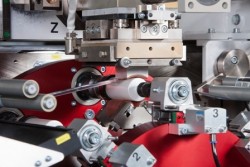 |
| ”With launching to the market a reliable and very precise Madag DecoRoll machinery producers of packaging for alcoholic beverages can decorate side walls as well as the top of the closure – there is even a possibility of embossing” – added Vincenzo Napolitano from Madag Printing Systems. |
Brunettes or blondes? Dubai or United States of America? Gold or silver? We make various, more or less important decisions on a daily basis. Sometimes the choice is determined by many factors, and sometimes it is just a matter of taste. From the packaging point of view, we ponder over the choice of packaging decoration and we enquire: hot- or cold stamping?
Hot stamping, also known as hot-printing, is a print technology with the use of hot-tamping foil and a die made of heat conducting material. PET foil consists of a separating layer, adhesive, vacuum dusted aluminium and varnish. Upon the contact of PET foil with the die (in the temperature of about 100°C ) the adhesive is activated in spots corresponding to the image on the die and, along with a relevant portion of varnish and aluminium layer, is transferred to the printed surface. Hot stamping application can be performed on flatbed, cylindrical and rotary machines. It is mainly used for finishing print, items decoration, marking and security print, for instance with the use of holographic foils. Cold stamping is a technique of applying gold and silver colours (various foil colours are offered - however in smaller colour scale than hot-stamping foils – as well as diffraction patterns and continuous holographic patterns, so-called ‘wallpaper’) on labels, which involves transferring the decorative layer of the foil onto the material with the use of special adhesive (UV-curable), which is applied using flexography, offset or typographic exactly in the spots that are supposed to be refined. After pressing the “printed” adhesive to the adhesive layer of the foil (and curing the adhesive with UV lamps through the foil) the pigment is separated from the carrier.
A matter of taste
Both methods give similar results, except that hot-stamping has a wider use (it enables application both on smooth and textured surfaces) and can be seen almost everywhere:
 |
on book covers, T-shirts or tv-sets, as well as tickets and credit cards. It may seem that with high temperature and strong pressure the application of very detailed patterns (the risk of the embossment “blending”) is definitely more difficult. Yet PC Print, the distributor of foils produced by L. Kurz, offers special foils dedicated to printing very small patterns with the use of hot-stamping, as well as foils that allow to achieve very precise hot-stamping in contra. The only restriction is the precision of preparing the stamping dies, but here the brass dies offered by Hinderer & Muehlich allow to achieve very good stamping effects. On the other hand cold stamping can be mainly seen on labels for groceries, chemical, pharmaceutical and cosmetic products. It may give a similar effect on lower expense owing to on-line foil printing and with the application of tonal effects. Flexographic printing house Natalii is one of sparse companies in Poland producing shrink sleeve labels with the use of cold stamping. According do Artur Nowaczyk, the vice-president, cold stamping has more advantages in comparison to hot stamping. “Even significantly processed shrink sleeve done with cold stamping is less expensive than the one produced with the application of rotogravure. It often happens that, owing to the high level of gloss, it gives even better visual effect. The use of gilt on flat surfaces is also more effective, since cold-stamping foil is rigid, and if significantly shrunk – it tarnishes, which sometimes gives surprisingly positive effects and new, interesting solutions.” What is more, cold-stamping foils are characterised with higher resolution thanks to application onto the surface with adhesive, which helps decorate products with more complicated patterns and thinner lines. The most significant disadvantage of this method is simultaneously its advantage – the efficiency of in-line production that requires the roll with foil to move at the same speed as the media, which means loss of about 10-15 per cent of the material; the smaller area of stamping in comparison to the print area, the greater loss of foil. However, machinery equipped with the foil saving system can be already observed on the market. It makes the foil move only by the stamping area. Cold-stamping is also supported by Jacek Gryska, production manager in Skanem Poznań. “If you compare two methods of gilting – hot and cold – definitely a better method of labels decoration is cold stamping – says Jacek Gryska. “One of the assets of cold-stamping is the capability of producing fast and simple photopolymer for any customer’s project without a necessity to order an expensive cylinder for hot stamping, which means quick and affordable prepress. Additionally, this technology enables faster changes on the machine without the need to wait for the cylinder cooling, better optimisation of the print on our RCS machinery and greater printing speed. We also eliminate the problem related to storage space required for keeping the boxes containing the cylinders.”
 |
| Stölzle recommends hot stamping foil for decoration of glass containers due to the stamping precision and cost effectiveness of this solution in comparison to other decoration techniques. |
Cold for cardboard packaging
Netbox – a company specialising in designing and production of cardboard packaging, manufactured with the use of flexographic printing also supports cold stamping. “Thanks to this technique we can offer our customers a wider range of both finishing print and security print with holographic foil” – says Bartosz Ziembiewicz, director of marketing and development. “The significant advantage is efficiency – the machinery is able to laminate at the maximum speed of 10 thousand sheets per hour. Owing to the modern technology we have a possibility of performing three technological process on-line: laminating, printing, dispersion or UV varnish. Cold stamping method enables reflecting tiny elements of graphics, even 0,05mm wide. The minus is higher requirements of a laminated medium – materials from GC group are preferred, whereas in case of materials from GD group it is required to perform tests to allow the material for production. To optimise the costs it is also important to prepare the sheets in a proper manner, as well as to use shared web instead of one roll.”
Revolution in sheets decoration?
“Until “cold” foil application on sheets appeared, it had been obvious to use hot-stamping for elegant cardboard packaging – claims Piotr Cippert, co-owner of PC Print (a representative of Leonhard Kurz – a manufacturer of foils dedicated to decorate various surfaces). After the new technology had been presented, representatives of cardboard packaging printers felt that a breakthrough in the sheet decoration technology happened. Many of them invested resources and purchased new multi-colour printing presses equipped with “cold-stamping” set. It was supported with a possibility to obtain EU funds to cover the cost of this innovative method of sheet decoration. Some printers were purchasing sets for cold-stamping dedicated to be installed on possessed printing presses. The euphoria related to the new possibilities of decoration resulted in the fact that currently nine printers can offer this technology. “One needs to be aware that the technology of cold foil transfer for cardboard sheets should not be considered as a competition to hot-stamping, but only as a method that allows to achieve unique decoration effects that are impossible to be achieved with the use of hot-stamping” – says Piotr Cippert. He believes that, in order to objectively answer the question which technology is better it is essential to evaluate the market feedback. “Today, after a couple of years since cold-stamping on cardboard sheets was introduced, it is seen that it has not been as successful as it was initially expected. The interest if end customers, despite numerous assets of this method, is not very large. The number of machines has significantly exceeded the market demand. The old hot-stamping technology is doing very well and has not been superseded by cold-stamping. Both technologies ought to be treated as complimentary. Each of them has its advantages as well as limitations. As always in such cases it is the customer who makes a decision which effects they expect to achieve on their packaging, and the designer and printer’s role is meet the customer’s expectations. Designers who understand the technology of cold foil transfer to the cardboard sheets plays the key role in the packaging creation. Our function, as a foil distributor, is to give full support both to designers and printers. PC Print, who has been offering Leonhard Kurz’s foils on Polish market for 20 years is faithfully to its mission. The company participated many times in the process of packaging creation by giving professional support both during the design and production stages” – summarised Piotr Cippert.
 |
| A significant asset of cold stamping is efficiency – the machine is able to laminate at the speed of up to 10 thousand sheets per hour. Thanks to modern technology we have an opportunity to perform three technological processes on-line: laminating, printing, dispersion or UV varnish” – says Bartosz Ziembiewicz, director of marketing and development at Netbox. |
Hot stamped glass
For glass decoration Stölzle recommends hot-stamping foil due to stamping precision and cost-effectiveness of this solution in comparison to other decoration techniques. Considering high prices of gold hot stamping has become an attractive alternative packaging gilding. “In the past to get a high quality prestigious-looking decoration on glass containers we had to use a ceramic flux and a precious metal (gold or silver). Both these materials have to be fired in kilns at various temperature and for different amounts of time, which resulted in the necessity to stamp the same packaging twice. Hot stamping using UV gives the same effect at lower cost, owing to the ability to do the decoration in one step cutting the decoration time by half” – commented Andreas Herzog, group decoration manager in Stölzle Oberglas. The additional advantage of the “hot” method is a wide choice of colours, a possibility to combine hot stamping with organic inks and deduction of waste material due to application of foil only after it has adhered to the printed image. The best evidence for the correctness of choosing this method is the fact that by the end of the current year Stölzle is planning to install another fully automatic hot-stamping machine with UV curing. The only issue with hot stamping on glass is lower strength of the material – ceramic inks are fired in 600°C and precious metals in 400°C, so the natural consequence is that their durability is better, which can be seen especially on large format artworks.
Power, style and money
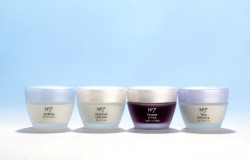
Among cosmetic producers, (especially luxurious products) hot stamping is preferred. Such an opinion is presented by Madag Printing Systems, Swiss producer of hot stamping machinery. “Tubes, crème jars, mascaras, perfume bottles or deodorant sticks are decorated mainly with hot stamping combined with other printing techniques such as dry offset, silk screen or flexo – only in case of very expensive brands hot stamping is used as the only decoration method. Why is it considered as the dot on the ‘i’? Because no other decoration technique allows to achieve this degree of gloss and brightness at a comparable price” – commented Vincenzo Napolitano, head of sales and marketing at Madag Printing Systems. This refers to silk screen which requires the use of expensive metallic inks, as well as to more expensive and less environmental friendly galvanic metallisation, which used to be the only technique allowing to decorate entire surface of packaging. “ Our customers are mainly interested in the “intrinsic value” of the decoration – hot stamped packaging looks attractive and symbolises power, classy and money. According to our knowledge cold stamping does not achieve the expected results on popular packaging materials for cosmetics, such as PE, PC, SAN, cardboard, metal or glass. We are curious how these techniques are going to develop in the future” – summarised Vincenzo Napolitano.
 |
| Owing to innovative solutions launched by Dekorglass, hot stamping can be applied as well for decoration of packaging for alcoholic beverages. This technique, thanks to low temperature of curing is applied to glass painted with watercolours. The effect of this technology is the achievement of metallic print highlighting the unique character of the brand. |
Which one and what for?
Finish printing with the use of hot- or cold stamping is quite a controversial and broad topic. “I was a witness, listener and participant of numerous such discussions” – informs Jan Borowiec, the owner of an advisory company specialising in packaging decoration. “During those discussions two fractions were formed, in which everybody defended and praised the technology they – as it turned out in the course of further considerations – used in their own company. The designers and customers’ visions are so challenging. The first selection of feasibility is verified during model preparation, the next verification takes place while testing the series production. During these tests one selects that technology which will allow the best and the most spectacular execution of the project. My recent works on packaging models reassure me that both these technologies will be, well! need to remain in use.” Hot stamping or cold stamping? Jan Borowiec believes that when discussing those technologies one cannot exclude any them, as the their specifics allow to use them simultaneously. “Thanks to them we can enrich the quality and visual effect of packaging, and what follows is variety and a range of combinations. Hot stamping is craft and experience that can be seen and felt, whereas cold stamping is enrichment extension of the opportunities that can be only seen. Thus, the answer to the question: hot or cold is definitely – both, for they complement each other! However, I skip the economic consideration or the issue of short runs or high volume production” – concludes Jan Borowiec.
|
Hot-stamping or cold-stamping? For such a question, each of the stakeholders will have a different answer, and their argumentation would be...that this is the technique offered by the respondent. From my point of view both techniques perfectly complement each other and give a full gamut of possibilities to the printer’s customer, whose needs are so miscellaneous that a choice of appropriate decoration, considering the project’s technological requirements, is a huge challenge. Additionally, we always need to take into account each project’s budget. I’m sure that, from the practical, technological and economical point of view, each printing house would like to have both technologies in their offer. Only such a situation would give a comfort of adjusting the method of decoration depending of the amount, project requirements and the budget. It is true that when having only one method at your disposal, you need to choose between the price and the quality. You are forced to find a compromise, which in case of premium packaging (S-druk specialises in this area) is not convenient and is not always satisfying for both the customer and the printer. Nowadays, hot-stamping seems to be a universal method in respect of current design assumptions and amounts commissioned by the clients. Both techniques have their advantages and disadvantages. However, considering the fact that cold-stamping is quite a new technology, I assume there is wide space for improvements. In the future, I seen significant chances for its domination over hot-stamping in the current form. To summarise and answer the question: hot- or cold-stamping? I would say that it should be always a conscious customers who makes a final decision. I’m consequent, seven years ago I chose hot-stamping, but at that time there was no cold-stamping... |
|
Cold-stamping: stages, disadvantages and limitations The method consists of four stages. The first one is application of adhesive on the first printing unit (it can be standard or UV adhesive). The second stage is “cold” foil application to the next, specially constructed printing unit. The third stage is separating the polyester film carrier – in case of the use of UV adhesive, after the contact of foil with the adhesive and carrier separation, it is required to “cure” the adhesive by irradiating the sheet with the use of UV lamps through the foil. The fourth stage is printing the sheets on further printing units. The printing can be done with conventional inks (if conventional adhesive was used) or (in case of UV adhesive) it can be done with both conventional and UV inks. Cold-stamping has its advantages and disadvantages. The advantages are as follows: - lack of stamping foil application - a possibility to apply the foil on the entire sheet at the speed of around 10 thousand sheets per hour - a possibility to use foil in the form of rolls cut to size - a possibility to achieve raster effects from the applied foil - a good quality of printing - a possibility to achieve diversified colour effects owing to the ease of printing with the use of transparent inks - no sheet deformation, which is especially important for low substrate weights - a possibility of on line and off line foil application
There are also some disadvantages: - the foil usage 1:1 in relation to the sheet size (the current solution by Heidelberg offers foils saving system) - difficulties in application of the foil on porous surfaces (it is advisable to use primers) - difficulties in foil application on non-absorbent substrates - no possibility to perform “in line” embossing |
| « previous | next » | « « back |